

Thinking Outside the Box
A cousin of my father’s was an artist in London. He could turn his hand to many mediums and was continually creative in how he responded to situations. He was once refused entry to a nightclub in the early 1970’s and, in response to this, when we came to visit he had printed t shirts for myself and my brother with a tie printed on the chest. “It means you can’t be refused entry for anywhere that requires a tie,” he told us, with a twinkle in his eye. Artists have an imaginative way of seeing and interpreting the world.
On the practical front, I have met many farmers who are very innovative in the way they find solutions to problems. They are very adept at using what is available to them in a given situation to make something work. So many individuals and businesses make use of apps and technology in a way that our ancestors could never have dreamed of.
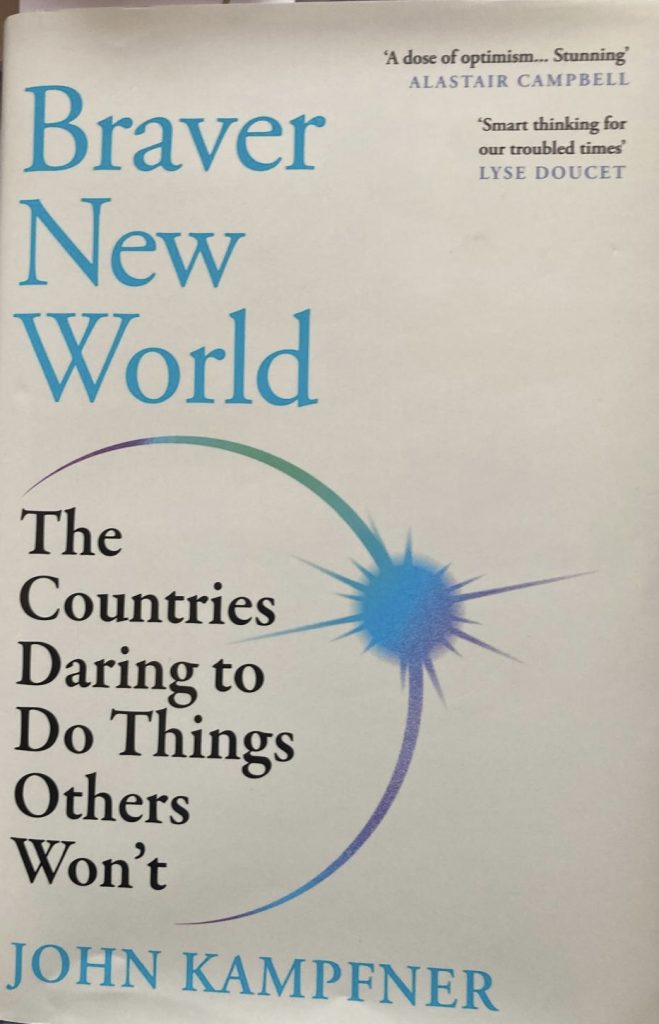
I’ve just started a fascinating book by the journalist John Kampner about countries that are responding imaginatively to some of the social problems, or issues, that confront them. They are not necessarily the richest countries in the world, but they have made courageous decisions to try to maximise their natural resources and to respond to issues or problems they can see coming down the tracks, if not immediately, in the years to come.
I’m currently reading about Japan that has the world’s oldest population, and how it is providing social care as people get older by combining community action and a radical insurance system, that people start paying into when they turn 40, to ensure the elderly population are well cared for and integrated with the younger population.
There are chapters about Vienna, one of the most sophisticated cities in Europe, and its culture of renting which has solved the problem of prohibitive housing costs. About 60 percent of the residents live in social housing.
Costa Rica has tripled its economy while doubling its forest cover, proving that green policies can pay direct dividends.
India’s leaders took unpopular decisions to turbo charge the country’s growth into a digital superpower, and India now accounts for more than half of the world’s digital payments.

When it emerged from Soviet occupation, Estonia transformed itself into a digital pioneer in a single generation, becoming the world’s first fully digital government where 97.6% of citizens access state services online.
Morocco is ahead of its target in terms of the Paris climate commitments and will see half its energy coming from renewables by 2030.
In the face of so much discussion about immigration, the first country to enshrine multiculturalism into its constitution, Canada, is showing that the key to making immigration work is making sure people feel the benefits.
There are lots of questions about schools and learning in the face of the rapid advance of artificial intelligence. Finland’s schools are the best in the world because of what and how they teach the next generation.
Through clever use of taxation and technology, Taiwan’s health system achieves 90% patient satisfaction at a fraction of the cost of the NHS and a fifth of the cost per person in America.
The stories of how these things are being achieved and the impact it has on individuals and families is fascinating to read about. It’s powerful to learn how countries are responding to what some may see as problems, as opportunities to do things in a different way.
It isn’t, or hasn’t been, a straightforward journey for the countries mentioned in this book. Some people don’t like the changes that have had to be made, governments have had to be brave in making big decisions that seek to make life better for everyone. Unpopular decisions on a political level can often have significant impact at the polling booth. How do these governments try to keep people on board as they do new things and make sweeping changes at times?
I think a large part of it is communication. It’s painting a picture, not only of what the present is with all its issues and challenges, but of what the future could look like for our children and grandchildren if bold decisions are made. It’s pointing out the unsustainability of certain practices and how continuing in them will wreck the future for those coming after us.
These are not easy things to convey when so many of us are caught up in the here and now and survival seems to take all we have.
In a time of much pessimism and global despair the book offers hope about what is possible when people work together and start to think outside the box. It asks us to consider what might be possible if we do things another way, while acknowledging that such choices will involve pain and sacrifice.
It prompts me to ask important and challenging questions about the future of the church. The models that we grew up in and love are not working well in the current generation. If we are brutally realistic, how long can we survive in our current incarnation?
I recently read an article which discussed how many teenagers are having more intimate relationships with Bots and artificial intelligence than they are with other human beings, including their parents and teachers and the detrimental effects technology is having on their mental health.
The church has always been a place where relationships are central. It offers a unique environment for the coming together of different generations and possibilities for connection and community. Although simple on many levels, I have enjoyed seeing this embodied in our community picnics over the summer. I see it when we get involved in fundraising or a cause that is bigger than ourselves.
Going deeper in the Christian faith, offering opportunities to others to encounter that faith, worship and praise, participating in communal activities are important. Serving our local community and those in need across the world often galvanises something important within us. Thinking not just of our needs but of the needs of future generations, what might that look like in practice for us as a congregation?
Looking forward to speaking again soon.
Much love to everyone,
Jono.
Listen to the latest episode of ‘Bitesize Chunks of Faith’